
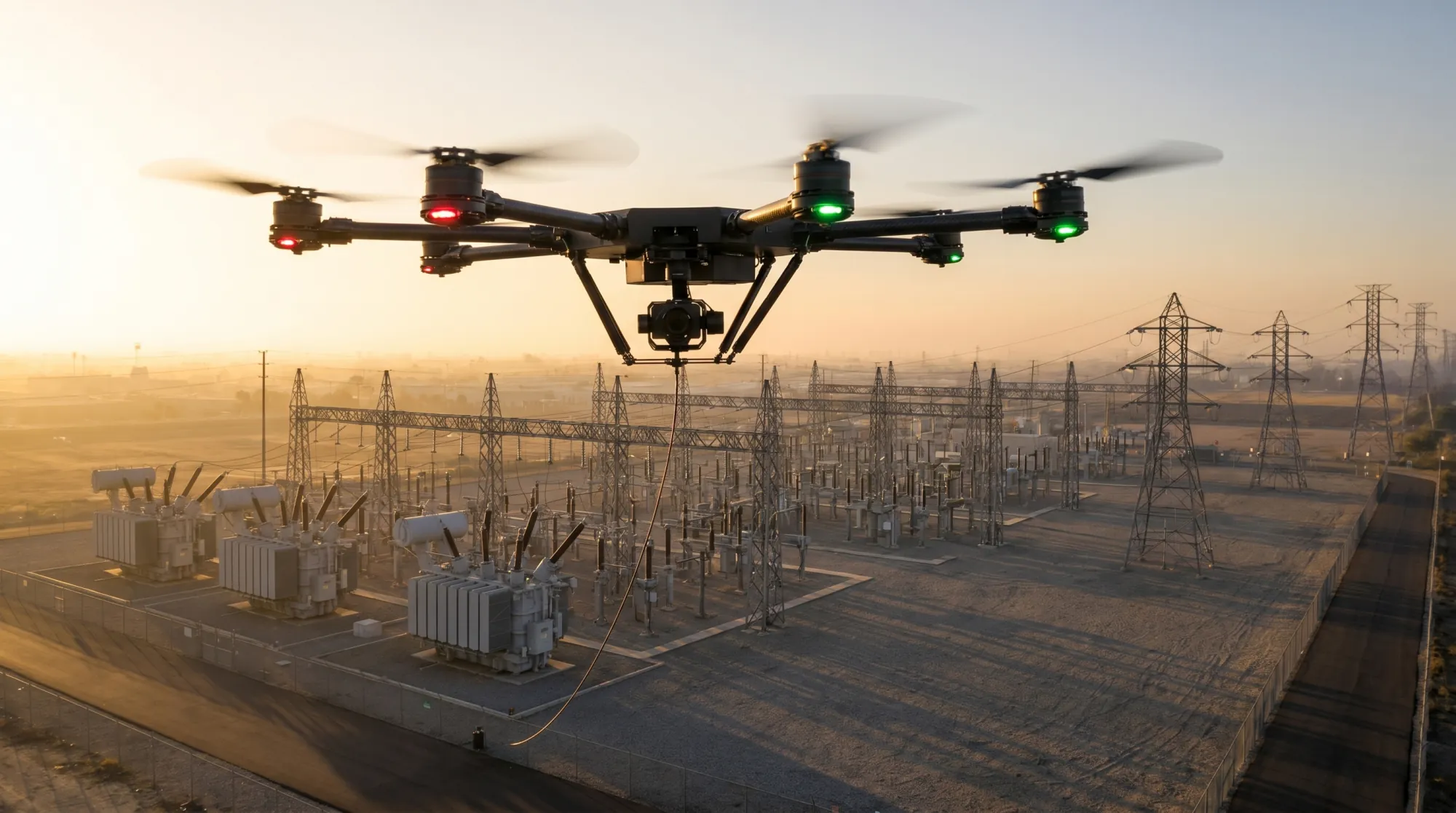
Every battery-powered drone program eventually learns the same lesson: the aircraft is never up when it matters.
Not because the aircraft is bad. Because of arithmetic. A capable multirotor gives you roughly twenty useful minutes aloft, then it lands, and then it spends two to three times that long charging or waiting for a battery swap. Run the numbers across a shift and a single free-flying aircraft covers maybe a third of the hours you actually care about — and the gaps don't land politely between events. They land during them.
The sortie mindset
Free flight pushes you into what we call the sortie mindset. You launch in response to something: an alarm, a call, a request from the yard manager. By the time the aircraft is overhead, the thing you wanted to see is usually over. The drone becomes a documentation tool — useful for the report, useless for the moment.
Operators compensate the way you'd expect. They schedule launches. They stage batteries. They hire more pilots. Each fix adds cost and coordination, and none of them changes the underlying fact: the picture has holes, and adversaries, accidents, and incidents do not check your charging schedule.
What changes at hour three
A tethered aircraft inverts the model. Power runs up the line continuously, so the question stops being "should we launch?" and becomes "what should we look at next?" That sounds like a small shift. Operationally it's everything.
At twenty minutes aloft, you point the camera at the thing you already knew about. At hour three, you start noticing patterns — the gate that gets propped open at shift change, the corner of the laydown yard the cameras can't see, the vehicle that's circled the perimeter twice. Persistence doesn't just extend the sortie. It changes what kind of information the vantage point produces.
The Apus 100 is built around that inversion: 8+ hours of continuous hover as a committed design target, at 100+ feet, holding a GPS-locked position within ±1 meter. The aircraft stays up because there is no battery to come down for.
Where sorties still win
Honesty matters here: free flight is the right tool whenever the mission is going somewhere — inspection runs along a pipeline, mapping a large area, chasing a moving incident across a city. A tether trades range for endurance, deliberately.
But most security, monitoring, and overwatch work isn't about going somewhere. It's about staying somewhere, with eyes that never blink. For that work, the math isn't close.
The honest comparison — tethered versus free-flying versus fixed cameras — is laid out here. For most persistent missions, the column that wins is the one that never lands.